
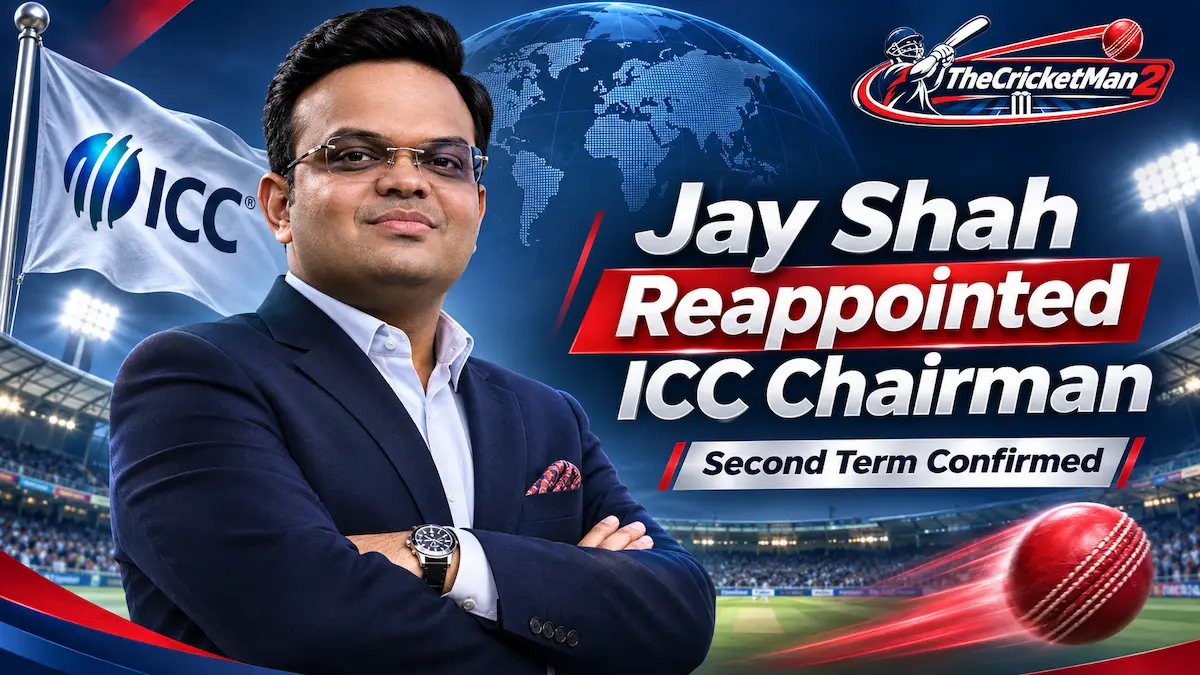
Jay Shah has been reappointed unopposed as Chairman of the International Cricket Council (ICC) for a second term, securing leadership continuity at the global cricket governing body during a period that includes the 2027 ODI World Cup, cricket’s return to the Olympic Games in 2028 and major changes to international tournament scheduling.
The ICC confirmed Shah’s reappointment following its Board meetings in Bali, Indonesia. The 38-year-old former BCCI secretary, who first assumed office on December 1, 2024, will continue in the position under the ICC’s revised leadership structure, which permits a maximum of two three-year terms.
His second term is expected to extend his chairmanship until December 2030, meaning he will oversee several major international cricket tournaments and the implementation of the ICC’s long-term development plans.
The decision comes alongside the approval of men’s international tournament windows through 2035, qualification reforms for upcoming ICC competitions and fresh discussions about how the global calendar could affect the Indian Premier League.
Jay Shah ICC Chairman: Key Details
| Detail | Information |
|---|---|
| Full name | Jay Shah |
| Age | 38 years |
| Current position | ICC Chairman |
| First appointed | August 27, 2024 |
| Assumed office | December 1, 2024 |
| Reappointment | November 2026 |
| Election outcome | Unopposed |
| Second-term tenure | 3 years |
| Expected tenure end | December 2030 |
| Maximum permitted tenure | 6 years across 2 terms |
| Previous position | BCCI Honorary Secretary |
| BCCI secretary tenure | 2019–2024 |
| Predecessor | Greg Barclay |
The ICC changed its constitutional rules in October 2024, replacing the previous arrangement of up to three two-year terms with a maximum of two three-year terms. The total six-year limit remained unchanged.
Shah’s first term therefore runs from December 2024 to late 2027, with his reappointment securing the subsequent three-year period through 2030.
Why Was Jay Shah Reappointed as ICC Chairman?
The ICC Board confirmed Shah’s second term without an opposing candidate following a proposal from its directors.
In its official announcement, the governing body identified global expansion, commercial development, growing cricket’s audience and strengthening international competitions as priorities for the coming years.
Shah expressed appreciation for the Board’s continued support and emphasised the importance of developing cricket beyond its established markets.
Speaking about the opportunity presented by the Los Angeles Olympics, he said:
“Cricket’s return to the Olympic Games at LA28 presents an extraordinary opportunity to introduce our game to new audiences and inspire a new generation of players and fans.”
The ICC also reiterated its commitments to women’s cricket, Associate Members, competitive international scheduling and protecting the integrity of the sport.
England and Wales Cricket Board Chair Richard Thompson welcomed the appointment while highlighting the need to maintain the importance of bilateral international cricket alongside expanding global competitions.
Jay Shah’s Second Term and the ICC ODI World Cup 2027
One of the biggest tournaments during Shah’s continued leadership will be the ICC Men’s Cricket World Cup 2027, jointly hosted by South Africa, Zimbabwe and Namibia.
The tournament will feature 14 participating teams, an increase from the 10-team format used in the 2023 edition.
That represents a 40% increase in participating teams, creating additional opportunities for emerging cricket nations.
ICC ODI World Cup 2027: Important Numbers
| Tournament detail | Confirmed information |
|---|---|
| Tournament dates | October 2 – November 21, 2027 |
| Host nations | South Africa, Zimbabwe, Namibia |
| Total participating teams | 14 |
| Total matches | 57 |
| Venues | 12 |
| Directly qualified teams | 10 |
| Places through qualifying | 4 |
| World Cup Qualifier teams | 10 |
| Qualifier matches | 23 |
| Final | November 21, Johannesburg |
The revamped competition introduces a Super Series before the main group stage.
Three teams emerging from the qualification pathway will contest the opening Super Series, with one progressing to join the other 11 teams in two groups of six.
The leading teams will then advance to the Super 7 stage before the semi-finals and final.
According to the ICC, the 2027 World Cup had already attracted more than 120 million ticket requests from approximately 2.8 million unique fans across 193 countries by early November. These figures represent ticket-ballot interest, not completed ticket sales.
The scale of the event highlights the commercial and organisational responsibilities facing the ICC during Shah’s next term.
Cricket Returns to the Olympics in 2028 After 128 Years
Perhaps the most significant international development during Shah’s chairmanship will be cricket’s return to the Olympic Games.
Cricket last appeared at the Olympics in Paris in 1900. Its inclusion in the Los Angeles 2028 Games therefore marks a return after 128 years.
The sport will feature separate men’s and women’s T20 competitions, each involving six teams.
The ICC has confirmed the locations, dates and formats of the final qualification tournaments.
LA28 Cricket Qualification Details
| Detail | Men’s competition | Women’s competition |
|---|---|---|
| Olympic teams | 6 | 6 |
| Format | T20 | T20 |
| Final qualifier host | Bangladesh | USA |
| Qualifier dates | February 5–13, 2028 | February 26 – March 5, 2028 |
| Teams in final qualifier | 8 | 8 |
| Qualifier matches | 13 | 13 |
| Final berth available | 1 | 1 |
India, Great Britain, Australia and South Africa have already secured women’s Olympic cricket places through the continental ranking qualification pathway.
The final qualification tournaments will feature two groups of four teams. Each group winner will advance to a final, with the winning side securing the remaining Olympic place.
For the ICC, the Olympics represent an opportunity to reach audiences in countries where cricket has historically had a limited following.
They also create a platform for the global governing body to pursue longer-term growth through grassroots development, women’s participation and new commercial partnerships.
ICC Announces Major Tournament Schedule Through 2035
Alongside Shah’s reappointment, the ICC Board approved established men’s global event windows extending through 2035.
The decision provides international teams, broadcasters, sponsors and cricket administrators with greater clarity about the timing of major competitions.
Confirmed Major ICC Tournament Windows
| Year | Tournament | Host nations | Dates |
|---|---|---|---|
| 2028 | Men’s T20 World Cup | Australia, New Zealand | Oct 12 – Nov 12 |
| 2029 | Champions Trophy | India | Oct 9–28 |
| 2030 | Men’s T20 World Cup | England, Ireland, Scotland | Jul 4 – Aug 4 |
| 2031 | ODI World Cup | India, Bangladesh | Oct 9 – Nov 23 |
| 2032 | Men’s T20 World Cup | To be confirmed | Oct 14 – Nov 14 |
| 2033 | Champions Trophy | To be confirmed | Oct 2–23 |
| 2034 | Men’s T20 World Cup | To be confirmed | Jul 6 – Aug 6 |
| 2035 | ODI World Cup | To be confirmed | Oct 2 – Nov 18 |
The approved schedule places several major white-ball ICC competitions in October and November, although the 2030 and 2034 Men’s T20 World Cups are scheduled for July and August.
The World Test Championship finals retain separate June windows in odd-numbered years.
This scheduling framework also has implications for domestic franchise leagues and bilateral international cricket.
Will the IPL Expand to 12 Teams Under the New ICC Calendar?
Shah’s reappointment has also brought renewed attention to the IPL’s future scheduling and commercial growth.
A report published by The Guardian suggested that the ICC’s long-term tournament calendar could create additional space for the IPL, particularly during the March-to-May period.
The report discussed the possibility of expanding the competition from 10 to 12 franchises or increasing the number of matches involving the existing teams.
However, neither proposal has received official BCCI approval.
BCCI Secretary Devajit Saikia said the Board had not discussed expanding the IPL to 12 teams in 2028, either formally or informally.
IPL Expansion: Current Position
| Proposal | Reported figure | Official status |
|---|---|---|
| Existing IPL franchises | 10 teams | Established |
| Possible expanded league | 12 teams | Not approved |
| Existing season size | 74 matches | Current format |
| Possible longer season | 94 matches | Reported possibility |
| Additional matches | 20 | Hypothetical |
| Percentage increase in matches | Approximately 27% | Hypothetical |
| Possible implementation | 2028 onward | Unconfirmed |
An increase from 74 to 94 matches would add approximately 27% more fixtures, potentially creating additional broadcasting and sponsorship inventory.
Nevertheless, international scheduling, player workloads, bilateral commitments and commercial agreements would all need to be considered before any expansion.
The confirmed development is the ICC’s new event calendar. A larger IPL remains a separate, unapproved possibility.
Jay Shah’s First Term: Major Cricket Developments
Shah arrived at the ICC after serving as BCCI Honorary Secretary from 2019 to 2024.
During his BCCI tenure, major initiatives included the introduction of the Women’s Premier League, equal international match fees for India’s male and female cricketers, the Test Cricket Incentive Scheme and development of the BCCI Centre of Excellence in Bengaluru.
His initial period at the ICC coincided with several major global tournaments.
| Year | Major development |
|---|---|
| 2019 | Became BCCI Honorary Secretary |
| 2023 | India hosted the Men’s ODI World Cup |
| 2024 | Took charge as ICC Chairman |
| 2025 | Men’s Champions Trophy returned after an eight-year gap |
| 2025 | ICC Women’s Cricket World Cup held |
| 2026 | Men’s T20 World Cup hosted by India and Sri Lanka |
| 2026 | Reappointed unopposed for a second ICC term |
The BCCI, while congratulating Shah on his reappointment, highlighted the Women’s Premier League, the growth of women’s international cricket and his involvement in the ICC’s Olympic planning.
These developments form part of the administrative record of his first two years in office, while the impact of longer-term changes will become clearer as future tournaments and qualification systems are implemented.
ICC’s Next Challenge: Media Rights, Women’s Cricket and Global Expansion
Shah’s next term will also coincide with important commercial decisions.
The ICC has established its major men’s event calendar through 2035, while media rights for the next broadcasting cycle are expected to be a significant focus.
The organisation must balance commercial returns from established cricket markets with efforts to increase participation and viewership elsewhere.
Women’s cricket and Associate Member development are central to those plans.
The newly approved 2028 Men’s T20 World Cup qualification pathway, for example, provides a 16-team Global Qualifier featuring 31 matches, with eight teams advancing to the main tournament.
The ICC has also confirmed that the final Women’s T20 World Cup 2028 Global Qualifier will provide two places at that tournament.
Such qualification systems are designed to provide more structured routes into global cricket competitions.
Shah’s continued leadership will be closely associated with how these plans translate into competitive opportunities, sustainable revenue and international growth.
What Jay Shah’s Reappointment Means for World Cricket
Jay Shah’s unopposed reappointment gives the ICC continuity in its leadership as the international game prepares for an expanded ODI World Cup, a historic Olympic return and a longer-term global tournament calendar.
The 2027 World Cup will introduce a 14-team format with 57 matches, while the Los Angeles Olympics will bring T20 cricket to a new international stage after 128 years.
Beyond these tournaments, attention will turn to media rights, women’s cricket, opportunities for emerging nations and how the ICC balances franchise leagues with international fixtures.
The Board has confirmed its leadership direction. The next measure of progress will be how the ICC implements those plans and what they deliver for players, member boards and cricket fans worldwide.
