
The International Cricket Council (ICC) has undergone major changes in its leadership structure since the early years of international cricket. From administration under the Marylebone Cricket Club (MCC) to the introduction of the ICC President and modern Chairman positions, the organisation has developed into the governing body responsible for international cricket.
For readers searching for the ICC Chairman List from 1947 to 2026, it is important to understand that the modern ICC Chairman position did not exist in 1947. The governing body was originally known as the Imperial Cricket Conference, and its administration remained closely connected to the MCC for several decades.
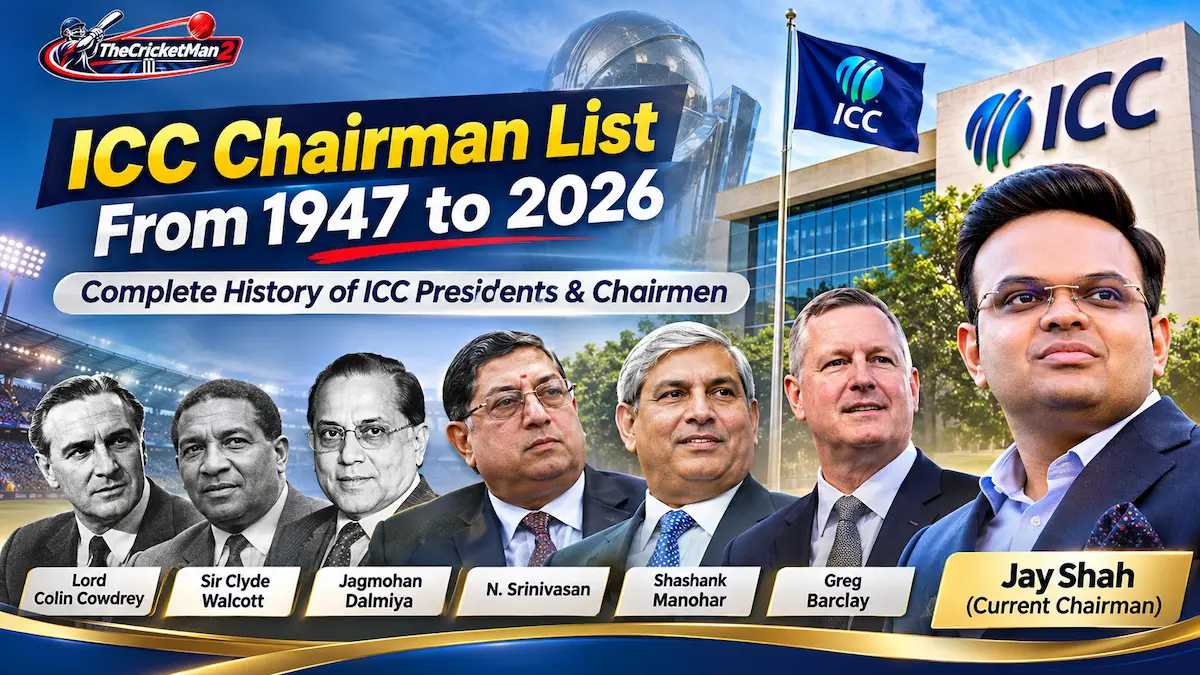
The ICC formally introduced its modern Chairman position in 2014, with N. Srinivasan becoming the first Chairman under the revised governance structure. Since then, Shashank Manohar, Greg Barclay and Jay Shah have held the position.
Jay Shah is the current ICC Chairman, having assumed office on December 1, 2024. In November 2026, he was reappointed unopposed for a second term, extending his expected tenure through December 2030.
This article covers the complete leadership timeline, all ICC Presidents and Chairmen, their countries, terms of office, historical changes and important records.
ICC Chairman List From 1947 to 2026: Quick Overview
| Details | Information |
|---|---|
| Organisation | International Cricket Council |
| Founded | 15 June 1909 |
| Original name | Imperial Cricket Conference |
| Name adopted in 1965 | International Cricket Conference |
| Current name adopted | 1989 |
| Leadership system in 1947 | MCC-linked administration |
| First president in official ICC list | Lord Colin Cowdrey (1989) |
| First modern ICC Chairman | N. Srinivasan (2014) |
| First independent elected Chairman | Shashank Manohar (2016) |
| Last ICC President | Zaheer Abbas (2015–2016) |
| Number of listed ICC Presidents | 12 |
| Number of modern ICC Chairmen | 4 |
| Current ICC Chairman | Jay Shah |
| Current Chairman’s country | India |
| Jay Shah’s term began | 1 December 2024 |
| Latest reappointment | November 2026 |
The ICC’s official records identify 12 Presidents between 1989 and 2016 and four permanent Chairmen under the governance structure introduced in 2014.
ICC Leadership History From 1947 to 2026
Cricket’s international administration evolved through several distinct periods. Although the ICC traces its foundation to 1909, the modern leadership structure emerged much later.
| Period | Governing body | Leadership arrangement |
|---|---|---|
| 1947–1964 | Imperial Cricket Conference | MCC-linked chairmanship and administration |
| 1965–1988 | International Cricket Conference | MCC President continued to chair the ICC |
| 1989–1996 | International Cricket Council | Elected leadership under Cowdrey and Walcott |
| 1997–2013 | International Cricket Council | President-led governance structure |
| 2014–2016 | International Cricket Council | Chairman and ceremonial President roles coexisted |
| 2016–2026 | International Cricket Council | Independent Chairman-led governance |
Who Was the ICC Chairman in 1947?
There was no separate, independently appointed ICC Chairman in 1947 comparable to the position that exists today.
At that time, the organisation was called the Imperial Cricket Conference. Its chairmanship was associated with the President of the Marylebone Cricket Club, while the MCC also handled administrative responsibilities.
This arrangement continued for several decades.
In 1989, the practice of the MCC President automatically chairing the ICC ended, marking an important shift towards independent international cricket governance.
The ICC subsequently strengthened its administration through the creation of a dedicated Chief Executive position in 1993.
Therefore, lists that assign modern ICC Chairman titles to individuals throughout 1947–1988 without explaining the MCC arrangement can be misleading.
Complete ICC Presidents List (1989–2016)
The ICC’s official historical records identify 12 individuals under its Presidents list.
Lord Colin Cowdrey and Sir Clyde Walcott were also described as Chairmen during their leadership periods. The later President position was formalised through governance reforms in 1997.
| No. | ICC President | Country / Region | Tenure |
|---|---|---|---|
| 1 | Lord Colin Cowdrey | England | 1989–1993 |
| 2 | Sir Clyde Walcott | West Indies (Barbados) | 1993–1997 |
| 3 | Jagmohan Dalmiya | India | 1997–2000 |
| 4 | Malcolm Gray | Australia | 2000–2003 |
| 5 | Ehsan Mani | Pakistan | 2003–2006 |
| 6 | Percy Sonn | South Africa | 2006–2007 |
| 7 | Ray Mali | South Africa | 2007–2008 |
| 8 | David Morgan | England | 2008–2010 |
| 9 | Sharad Pawar | India | 2010–2012 |
| 10 | Alan Isaac | New Zealand | 2012–2014 |
| 11 | Mustafa Kamal | Bangladesh | 2014–2015 |
| 12 | Zaheer Abbas | Pakistan | 2015–2016 |
Note: The ICC’s historical Presidents list includes Cowdrey and Walcott, although its own records also describe both as having held the Chairman title. Mustafa Kamal and Zaheer Abbas served in the ceremonial presidency after the 2014 governance reforms.
1. Lord Colin Cowdrey (1989–1993)
Lord Colin Cowdrey was the first individual included in the ICC’s official Presidents list. The former England Test cricketer became the organisation’s elected leader after the previous MCC-linked arrangement ended in 1989.
During this period, international cricket administration began moving towards a more independent structure.
2. Sir Clyde Walcott (1993–1997)
Sir Clyde Walcott, the former West Indies cricketer from Barbados, succeeded Cowdrey in 1993.
He became the first non-British Chairman in the ICC’s historical leadership structure.
His tenure coincided with the creation of a separate ICC Chief Executive position and further administrative independence from the MCC.
3. Jagmohan Dalmiya (1997–2000)
Jagmohan Dalmiya became the first Indian to hold the formal ICC President position.
His appointment followed structural changes in 1997 that established a new executive board-based governance model.
Dalmiya’s tenure also coincided with the increasing commercial importance of international cricket broadcasting and major global tournaments.
4. Malcolm Gray (2000–2003)
Australian cricket administrator Malcolm Gray succeeded Dalmiya in 2000.
His presidency covered a period when international cricket was strengthening its administrative and regulatory systems.
5. Ehsan Mani (2003–2006)
Ehsan Mani became ICC President in 2003, representing Pakistan.
His tenure included the ICC’s relocation of its headquarters from Lord’s to Dubai in August 2005.
6. Percy Sonn (2006–2007)
South African administrator Percy Sonn served as ICC President from 2006 to 2007.
He previously held significant responsibilities in international cricket governance.
7. Ray Mali (2007–2008)
Ray Mali, another South African cricket administrator, served as ICC President following Sonn.
His tenure lasted approximately one year.
8. David Morgan (2008–2010)
David Morgan of England became ICC President in 2008.
He previously served as Chairman of the England and Wales Cricket Board.
9. Sharad Pawar (2010–2012)
Sharad Pawar became the second Indian to hold the ICC President position.
He had previously served as President of the Board of Control for Cricket in India (BCCI).
His ICC presidency ran from 2010 to 2012.
10. Alan Isaac (2012–2014)
Alan Isaac of New Zealand became ICC President in 2012.
His term preceded the important constitutional reforms introduced in 2014.
11. Mustafa Kamal (2014–2015)
Mustafa Kamal of Bangladesh served as ICC President between 2014 and 2015.
By this stage, the President had become a ceremonial office following the establishment of the modern ICC Chairman position.
12. Zaheer Abbas (2015–2016)
Former Pakistan cricketer Zaheer Abbas became the final ICC President in 2015.
The presidency was abolished in 2016, leaving the independent Chairman as the organisation’s principal leadership position.
Complete ICC Chairman List (2014–2026)
The modern ICC Chairman position was introduced following constitutional reforms approved in June 2014.
Only four individuals have permanently held the modern Chairman office through 2026.
| No. | ICC Chairman | Country | Tenure | Status |
|---|---|---|---|---|
| 1 | N. Srinivasan | India | 2014–2015 | Former |
| 2 | Shashank Manohar | India | 2015–2020 | Former |
| 3 | Greg Barclay | New Zealand | 2020–2024 | Former |
| 4 | Jay Shah | India | 2024–present | Current |
Additional leadership detail: Imran Khwaja of Singapore served as Acting ICC Chairman between July and November 2020, following Manohar’s departure and before Barclay’s election. He is not counted among the four permanent modern Chairmen.
N. Srinivasan – First Modern ICC Chairman (2014–2015)
N. Srinivasan became the first Chairman under the modern ICC governance structure after constitutional changes were approved at the ICC Annual Conference in Melbourne on June 26, 2014.
A former BCCI President, Srinivasan was nominated by the Indian cricket board for the newly established position.
His tenure marked a major change in the distribution of responsibilities within the ICC, as the Chairman became the organisation’s principal leadership figure.
Shashank Manohar – ICC Chairman (2015–2020)
Shashank Manohar succeeded Srinivasan in 2015 and remained ICC Chairman until June 2020.
In May 2016, following further constitutional amendments, he became the first independently elected ICC Chairman.
The distinction matters because Srinivasan had already held the modern Chairman office before those independence-related reforms.
Manohar was elected unopposed for another two-year term in May 2018.
He remains the longest-serving of the four permanent modern ICC Chairmen through 2026, having held the position for more than four and a half years.
Greg Barclay – ICC Chairman (2020–2024)
Greg Barclay, a New Zealand commercial lawyer and former New Zealand Cricket director, was elected ICC Chairman on November 24, 2020.
He succeeded the period of interim leadership under Deputy Chairman Imran Khwaja.
Barclay was re-elected in November 2022 for another two-year term.
His tenure included the organisation’s recovery from the disruption caused by the COVID-19 pandemic and major developments in international cricket’s tournament and commercial planning.
Barclay decided not to seek another term and concluded his chairmanship in November 2024.
Jay Shah – Current ICC Chairman (2024–Present)
Jay Shah became ICC Chairman on December 1, 2024, succeeding Greg Barclay.
He was elected unopposed in August 2024, becoming the youngest person to take charge of the global cricket governing body.
Before assuming the ICC position, Shah served as BCCI Honorary Secretary from 2019 to 2024 and held leadership responsibilities within the Asian Cricket Council.
His cricket administration career began in Gujarat in 2009.
During his BCCI tenure, developments included the launch of the Women’s Premier League, the IPL’s major media rights agreement, the Test Cricket Incentive Scheme and the establishment of a new Centre of Excellence.
Jay Shah Reappointed as ICC Chairman for Second Term in 2026
On November 16, 2026, the ICC confirmed Jay Shah’s unopposed reappointment for a second term following Board meetings in Bali, Indonesia.
His continued leadership comes as cricket prepares for significant global developments, particularly the 2027 ODI World Cup and the sport’s return to the Olympic Games at Los Angeles 2028.
Jay Shah ICC Chairmanship: Important Dates
| Event | Date / Period |
|---|---|
| First elected ICC Chairman | 27 August 2024 |
| First term began | 1 December 2024 |
| Reappointed unopposed | 16 November 2026 |
| Expected first-term completion | November 2027 |
| Expected end of second term | December 2030 |
| Maximum permitted tenure | Two terms of three years |
The ICC Board proposed changes to the Chair’s term limits in October 2024, moving towards a maximum of two three-year terms instead of the previous system of up to three two-year terms.
Under the revised arrangement, Shah is expected to remain Chairman until December 2030.
The ICC has identified international expansion, women’s cricket, opportunities for Associate Members and sustainable commercial growth as important priorities during his continued leadership.
List of Indian ICC Presidents and Chairmen
India has produced five different individuals who have held the ICC President position or served as permanent Chairman under the modern system.
| No. | Indian administrator | Position | Tenure |
|---|---|---|---|
| 1 | Jagmohan Dalmiya | ICC President | 1997–2000 |
| 2 | Sharad Pawar | ICC President | 2010–2012 |
| 3 | N. Srinivasan | ICC Chairman | 2014–2015 |
| 4 | Shashank Manohar | ICC Chairman | 2015–2020 |
| 5 | Jay Shah | ICC Chairman | 2024–present |
Three of the four permanent modern ICC Chairmen have been Indian administrators.
That represents 75% of the permanent modern Chairman appointments between 2014 and 2026.
However, the earlier President and Chairman offices had different responsibilities, so their tenures should not be treated as directly equivalent.
ICC Presidents and Chairmen: Country-Wise Statistics
The ICC’s modern and historical leadership lists also provide an interesting picture of the countries represented.
| Country / Region | ICC Presidents | Modern ICC Chairmen | Total |
|---|---|---|---|
| India | 2 | 3 | 5 |
| England | 2 | 0 | 2 |
| Pakistan | 2 | 0 | 2 |
| South Africa | 2 | 0 | 2 |
| New Zealand | 1 | 1 | 2 |
| Australia | 1 | 0 | 1 |
| West Indies | 1 | 0 | 1 |
| Bangladesh | 1 | 0 | 1 |
| Total | 12 | 4 | 16 |
The table counts permanent officeholders in the ICC’s published Presidents and modern Chairmen lists. It excludes Acting Chairman Imran Khwaja and the MCC-linked administrators who chaired the organisation before 1989.
India accounts for five of the 16 listed individuals, equivalent to 31.25% of these historical President and modern Chairman appointments.
Important Milestones in ICC Leadership History
| Year | Major milestone |
|---|---|
| 1909 | Imperial Cricket Conference established |
| 1947 | Organisation operated under MCC-linked administration |
| 1952 | Pakistan admitted to the ICC |
| 1965 | Renamed International Cricket Conference |
| 1975 | First Men’s Cricket World Cup staged |
| 1989 | Renamed International Cricket Council; MCC President’s automatic chairmanship ended |
| 1993 | First ICC Chief Executive appointed |
| 1997 | New President-led governance structure introduced |
| 2005 | ICC headquarters moved to Dubai |
| 2014 | Modern ICC Chairman office established |
| 2016 | ICC President position abolished; independent Chairman elected |
| 2020 | Greg Barclay elected Chairman |
| 2024 | Jay Shah assumed chairmanship |
| 2026 | Jay Shah reappointed for a second term |
Difference Between ICC President and ICC Chairman
Although both titles appear in ICC history, their meaning changed as the governing body’s constitution evolved.
| Feature | ICC President | Modern ICC Chairman |
|---|---|---|
| Historical period | 1989–2016 | 2014–present |
| Nature of role | Changed over time; ceremonial after 2014 | Principal Board leadership |
| Selection | Varied under historical governance rules | Elected through ICC Board process |
| Governance authority | Previously significant; reduced after 2014 | Leads Board governance |
| Current status | Abolished | Active |
| Final / current officeholder | Zaheer Abbas | Jay Shah |
The introduction of the modern Chairman position in 2014 and the subsequent removal of the presidency in 2016 were two separate milestones.
In 2016, the ICC also established the independent Chairman election framework under which Shashank Manohar was elected.
Conclusion
The history of ICC leadership from 1947 to 2026 reflects cricket’s transformation from an organisation closely associated with the MCC into a global governing body with independent administration.
The modern Chairman position was introduced in 2014, replacing an earlier governance system in which the President had held a central leadership role.
Since that change, four permanent ICC Chairmen have served: N. Srinivasan, Shashank Manohar, Greg Barclay and Jay Shah.
With Shah’s second term confirmed in November 2026, the ICC enters another important period involving international tournament expansion, the 2027 ODI World Cup, the Los Angeles 2028 Olympics and cricket’s evolving global schedule.
Understanding the distinction between Presidents, historical Chairmen and the modern independent Chairman position is essential when reviewing the full ICC leadership history.
