

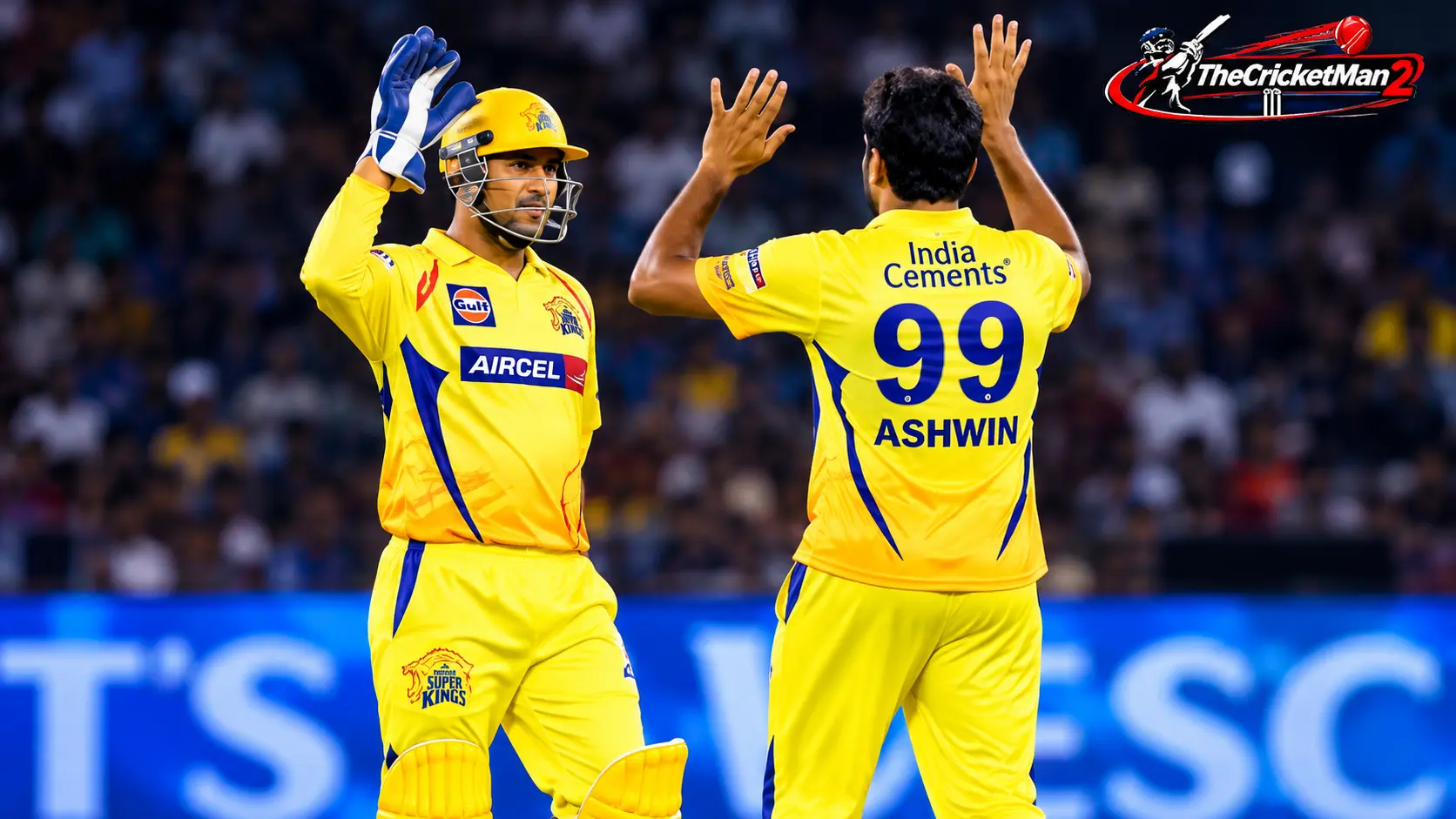
Former India off-spinner Ravichandran Ashwin has recalled how MS Dhoni brought him back into the Chennai Super Kings playing XI during IPL 2010 after he was dropped when Suresh Raina temporarily captained the franchise. Ashwin also revealed how Dhoni trusted him with the new ball and allowed him to set his own field placements, an approach that continued into his international career.
Ravichandran Ashwin has shared an interesting account of MS Dhoni’s influence on his early cricketing career, revisiting a difficult period during the Indian Premier League (IPL) 2010 season when he lost his place in the Chennai Super Kings (CSK) side.
Speaking during a conversation with former India opener Aakash Chopra on the Baith & Bol podcast, Ashwin explained how Dhoni’s return from injury helped him regain his position and establish himself as a regular bowling option.
The former Indian spinner revealed that he initially played three or four matches under Dhoni’s captaincy before the CSK skipper suffered an injury. Suresh Raina subsequently took charge of the franchise, during which Ashwin found himself out of the team.
However, the situation changed when Dhoni returned. According to Ashwin, the captain not only brought him back but also trusted him to bowl with the new ball during the powerplay.
Ravichandran Ashwin Recalls Being Dropped During IPL 2010
Ashwin’s early years with Chennai Super Kings were far from straightforward. Although he had been associated with the franchise since 2008, opportunities were limited because CSK already had established international spin options, including Sri Lankan legend Muttiah Muralitharan.
He made his IPL debut in 2009 but played only a small number of matches before becoming a more regular member of the side in 2010.
Recalling the events of that season, Ashwin explained that he lost his position after Dhoni suffered an injury and Raina temporarily assumed the captaincy.
During the conversation, Ashwin said he had featured in the opening few games before being left out of both the playing XI and the squad.
He did not portray the incident as a personal disagreement with Raina. Instead, his recollection highlighted how different captains approached team selection and bowling responsibilities.
The turning point came when Dhoni returned and restored Ashwin to the side.
How MS Dhoni Trusted Ashwin With the New Ball
One of the most revealing aspects of Ashwin’s account was Dhoni’s willingness to use a young off-spinner with the new ball.
Traditionally, IPL teams have relied heavily on fast bowlers during the opening overs. However, Dhoni regularly used Ashwin during the powerplay, particularly when matchups against opposition batters favoured spin.
Ashwin explained that Dhoni trusted him to assess the batter, choose his field placements and execute his bowling plans.
Rather than constantly changing the field or dictating his approach, Dhoni allowed the spinner to make decisions based on his own preparation.
According to Ashwin, that trust continued throughout their association with Chennai Super Kings and the Indian national team.
This approach became an important feature of their partnership. Dhoni’s role was to provide the opportunity, while Ashwin was responsible for delivering his plans on the field.
The decision was significant because bowling inside the powerplay can expose a spinner to attacking batters while fielding restrictions are in place.
Ashwin Reveals Dhoni Never Set His Field Placements
Ashwin also offered an insight into the freedom Dhoni gave him during matches.
During the podcast, the veteran spinner recalled that Dhoni rarely interfered with his field placements, allowing him to take responsibility for his bowling strategy.
“He never set the field for me at all,” Ashwin said while discussing his experience under Dhoni’s captaincy.
The arrangement required Ashwin to understand opposition batters, identify scoring areas and adjust his bowling accordingly.
It also meant he had to accept responsibility when a particular plan failed.
Ashwin said the same approach continued when he represented India under Dhoni. The former captain’s confidence helped him develop his decision-making as an international bowler.
Their partnership eventually became an important part of India’s spin-bowling attack across formats.
Ravichandran Ashwin IPL 2010 Stats: Matches, Wickets and Economy Rate
Ashwin’s statistics from IPL 2010 demonstrate how effectively he performed after establishing himself in the CSK bowling attack.
The off-spinner finished the season with 13 wickets in 12 matches and maintained an economy rate of just 6.10 runs per over.
R Ashwin IPL 2010 Bowling Statistics
| Statistic | IPL 2010 record |
|---|---|
| Team | Chennai Super Kings |
| Matches | 12 |
| Bowling innings | 12 |
| Overs bowled | 48 |
| Wickets | 13 |
| Runs conceded | 293 |
| Bowling average | 22.53 |
| Economy rate | 6.10 |
| Bowling strike rate | 22.15 |
| Best bowling figures | 3/16 |
| Three-wicket hauls | 1 |
| Maiden overs | 1 |
Ashwin’s economy rate of 6.10 was the best among bowlers meeting the qualification threshold of more than 50 balls in the 2010 season.
His average of 22.53 meant he conceded approximately 22.5 runs for each wicket taken, while his strike rate indicated a wicket roughly every 22 deliveries.
These figures reflected his ability to control scoring and take wickets in a format that increasingly rewarded aggressive batting.
Ashwin’s Role in Chennai Super Kings’ IPL 2010 Title Victory
The 2010 season was historic for Chennai Super Kings, who won their maiden IPL title under Dhoni’s captaincy.
CSK defeated Mumbai Indians by 22 runs in the final at the DY Patil Stadium in Navi Mumbai on 25 April 2010.
Chennai posted 168/5 in their 20 overs, with Suresh Raina leading the batting effort through an unbeaten 57 from 35 deliveries.
Mumbai Indians, led by Sachin Tendulkar, managed 146/9 in reply.
IPL 2010 Final: CSK vs MI Scorecard Summary
| Match detail | Result |
|---|---|
| Final | Chennai Super Kings vs Mumbai Indians |
| Date | 25 April 2010 |
| Venue | DY Patil Stadium, Navi Mumbai |
| CSK score | 168/5 (20 overs) |
| MI score | 146/9 (20 overs) |
| Winning margin | CSK won by 22 runs |
| Top CSK scorer | Suresh Raina – 57* (35) |
| Top MI scorer | Sachin Tendulkar – 48 (45) |
| Player of the Match | Suresh Raina |
| Ashwin’s bowling | 4-1-24-0 |
Although Ashwin did not take a wicket in the final, he bowled four overs for just 24 runs, including a maiden, maintaining an economy rate of 6.00.
His economical spell helped Chennai restrict Mumbai’s batting lineup during the title-deciding contest.
The tournament ultimately marked an important step in Ashwin’s emergence as a dependable T20 spinner.
From 13 Wickets in 2010 to 20 Wickets in IPL 2011
Ashwin continued his progress during the following season as Chennai Super Kings defended their IPL title.
In IPL 2011, he claimed 20 wickets in 16 matches at a bowling average of 19.40 and an economy rate of approximately 6.16.
His performances demonstrated that the previous season was not an isolated success.
| Season | Team | Matches | Wickets | Economy |
|---|---|---|---|---|
| IPL 2009 | CSK | 2 | 2 | 3.25 |
| IPL 2010 | CSK | 12 | 13 | 6.10 |
| IPL 2011 | CSK | 16 | 20 | 6.16 |
Across the 2010 and 2011 seasons, Ashwin took 33 wickets in 28 matches as Chennai Super Kings claimed consecutive IPL titles.
One memorable moment came during the 2011 final against Royal Challengers Bangalore, when Dhoni entrusted Ashwin with the new ball against Chris Gayle.
Ashwin dismissed the dangerous West Indies batter for a duck, helping CSK secure another championship.
How MS Dhoni Influenced Ashwin’s International Career
Ashwin’s success in domestic cricket and the IPL eventually translated into opportunities with the Indian national team.
He made his ODI debut against Sri Lanka in June 2010 and his Test debut against the West Indies in November 2011.
Under Dhoni’s leadership, Ashwin developed into an important member of India’s bowling attack, particularly in Test cricket.
The spinner went on to finish his Test career with 537 wickets in 106 matches, becoming one of the most successful bowlers in Indian cricket history.
He also recorded six Test centuries, demonstrating his value as a lower-order batter.
Ashwin’s international achievements were built over many years and under different captains, but his latest recollections underline the importance he places on Dhoni’s early confidence in his abilities.
The former spinner has previously discussed how Dhoni encouraged him to retain his natural variations and avoid overcomplicating his bowling.
Why Ashwin’s IPL 2010 Revelation Matters
The latest conversation provides an insight into a formative period in Ashwin’s career.
His account highlights three important elements of captaincy: recognising a player’s strengths, providing opportunities during difficult phases and allowing experienced players to take responsibility for their decisions.
Dhoni’s decision to use Ashwin with the new ball was an important tactical choice, particularly at a time when franchises generally preferred pace bowlers during the powerplay.
Ashwin’s performances subsequently justified that confidence, as he developed into one of Chennai Super Kings’ most effective spin-bowling options.
His recollection also explains why he has repeatedly spoken positively about Dhoni’s role in his development.
Conclusion
Ravichandran Ashwin’s account of his IPL 2010 setback offers a perspective on the early relationship between the off-spinner and MS Dhoni.
After losing his place during Dhoni’s injury absence, Ashwin was brought back into the Chennai Super Kings setup and given a defined role with the new ball.
He responded with 13 wickets in 12 matches during the franchise’s maiden IPL-winning season, followed by another 20 wickets in their successful 2011 campaign.
More than a decade later, Ashwin’s recollections highlight how trust, tactical clarity and freedom on the field contributed to the development of one of India’s leading spin bowlers.
